Showing posts with label eurozone crisis. Show all posts

Tuesday, June 19, 2012

This is a Common Labor Market?

ZeroHedge provides the following graph that illustrates the perils of monetary union when language and culture inhibit labor mobility:


In the Unites States workers tend to move from state to state in search of jobs. In Europe, this apparently isn't happening; so Spain continues to suffer high unemployment and rising interest rates on its sovereign debt, even though theoretically its unemployed could find work in Germany. American work force mobility provides for a more robust economy because local conditions in North Dakota, for example, provide high levels of employment that can sop up unemployed workers from other parts of the country. However, I believe that the housing crisis uniquely harmed the U.S. economy because it interfered with this key corrective. Under more normal circumstances, people are able to sell their homes at only slight losses to move to other locales to take jobs. With the collapse of the housing bubble, many people are holding out, perhaps irrationally for a recovery of their home prices, before they make a move.

The administration's policies have contributed to the prolonged recession in two ways. First, by intervening in the housing market, and propping it up, the administration prevented the market from hitting bottom and perhaps recovering. I believe, though with only anecdotal evidence, that people are clinging to their homes, not wanting to sell. This is inhibiting labor mobility as people stay put. Second, by prolonging unemployment benefits, people are encouraged to try to hang on longer in their perhaps underwater homes; waiting for a recovery.

Wednesday, December 14, 2011

In the Unlikely Event of a Water Landing

I work in IT management, and preparing for contingencies and product launch failures and delays is a prudent part of my daily routine. We always joke about the process, because unlike airlines, where water landings are very rare, apparently, disasters are more routine in IT. Which brings me to the euro. Here is a little tidbit that is an indicator of the euro's long term health.

At least one—the Central Bank of Ireland—is evaluating whether it needs to secure additional access to printing presses in case it has to churn out new bank notes to support a reborn national currency, according to people familiar with the matter.


So, in the unlikely event of a water landing. Just a friendly warning. I cashed out an international fund six weeks ago and put the funds in U.S. corporate bonds. The more I study the problem the more I am convinced that the euro can't survive. More than one prominent economist points to the huge productivity growth disparity between Germany and the rest of the euro zone, which is not compensated for by wage disparity, as the reason the euro can't survive. Alan Blinder has a very readable explanation here.

Tuesday, November 1, 2011

Taking Responsibility in Greece

I had the same reaction as fellow SLOB KT, regarding the decision by Greek PM George Papandreou to call a referendum on the euro bailout package. (By the way, I'd like to welcome KT to the SLOBs, he is a great addition, as well as a good friend.) The Greek people need to face up to their own responsibility for their future. A referendum is a good way to concentrate their attention and take the air out of their childish demands to be bailed out without making any fundamental changes to their system of government or economy.

Further, from a political perspective, the prime minister has little to lose. The New York Times is reporting that his government may collapse over the referendum question. But he was already a dead man walking, politically; new elections would give him a fresh mandate to govern or toss the problem to some other hapless sap who would have to live with the consequences of either default or austerity.

My personal opinion is that the Greeks should just default and exit the eurozone. They have proved they can't live within the rules laid down by the union, and full default, like bankruptcy would give a fresh start. The lack of foreign meddling would also concentrate the minds of the Greeks on solving their own problems, starting by re-instituting real capitalism and getting the government out of the shipping and tourism industries. Where would they get the capital to grow? They still own plenty of assets, including many islands that the wealthy or large corporations would love to lease or buy.


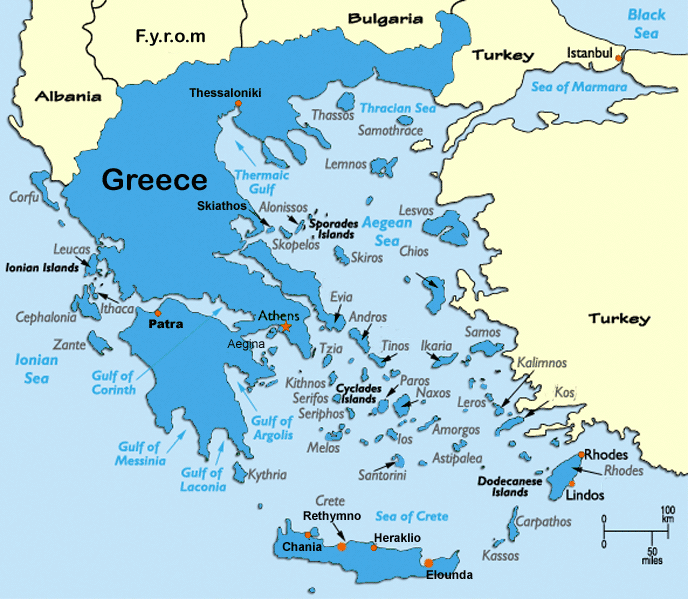
Here is a picture from the Greek island of Ios.


This could be the start of the Greek nation making a comeback. The first step is always taking responsibility for one's self.