Showing posts with label ISIS. Show all posts

Sunday, June 7, 2015

Taking Sides in a Religious Civil War

In order to to not offend Muslims, the President has taken pains to try to distance himself from the idea that we are fighting a religious war, so as not to offend Muslim allies.  This is understandable, but shows a lack of understanding of the true nature of the problem.  His administration has taken to saying silly things such as ISIS is not truly Islamic.  This could not be further from the truth, ISIS is nothing if not Islamic.  Their leader, Abu Bakr al-Baghdadi, is believed to have a doctorate in Islamic studies and certainly speaks with the rhetorical flourishes characteristic of a learned Muslim scholar.  Graeme Wood's excellent article in the Atlantic says this about ISIS' Islamic pedigree.
The reality is that the Islamic State is Islamic. Very Islamic. Yes, it has attracted psychopaths and adventure seekers, drawn largely from the disaffected populations of the Middle East and Europe. But the religion preached by its most ardent followers derives from coherent and even learned interpretations of Islam.
. . .
The Islamic State, also known as the Islamic State of Iraq and al-Sham (ISIS), follows a distinctive variety of Islam whose beliefs about the path to the Day of Judgment matter to its strategy, and can help the West know its enemy and predict its behavior. Its rise to power is less like the triumph of the Muslim Brotherhood in Egypt (a group whose leaders the Islamic State considers apostates) than like the realization of a dystopian alternate reality in which David Koresh or Jim Jones survived to wield absolute power over not just a few hundred people, but some 8 million.
Essentially, ISIS represents a sect of Islam that is different but related to Salafism, a Sunni sect.  We are witnessing a civil war within Arab Islam that has ethnic and tribal components as well, typical of any civil war.  We are choosing to take sides in this religious civil war, because it is in our national interest to do so. We make no judgment about the theological correctness of any side. We merely seek the defeat of those who have pledged destruction of us and our allies.  In Islamic thought, there is no distinction between the political and the religious, so when we attack ISIS' conception of political rule, we engage in a religious war whether we like it or not.

CDR Salamander's shorter summary, "Often, it isn't what you think about religion that matters, it is what the other guy thinks."

The harder question is what to do about the problem.  By taking sides in the conflict, we risk granting moral authority to ISIS which can correctly claim that America, (the Great Satan or some such term for infidels) is supporting other forms of Islam.  The obvious inference is that the Salafist Saudis or Shiite Iraqis are therefore tainted by our help.  This tends to draw recruits to ISIS sides, because in the 21st Century, people appear to be craving the moral certainty such a brand of religion brings.

Failure to intervene works against our interest as it brings to power a religious and political movement inimical to our goals of stability and peace throughout the world.  From the same Graeme Wood article:
Abu Baraa, who maintains a YouTube channel about Islamic law, says the caliph, Baghdadi, cannot negotiate or recognize borders, and must continually make war, or he will remove himself from Islam.
This is a classic wicked problem, defined as such because any attempt to solve the problem only seems to make the problem worse.  The best option appears to be to provide support to those reliable allies such as the Kurds who won't be tainted by U.S. help.  Putting boots on the ground only as a last resort to prevent catastrophes would also be necessary.  Finally, given the Caliphate's (ISIS' term for itself) need to continually be at war, a slow bleed of its resources and war making capacity is needed.  This would mean bypassing the national Iraqi army, as equipment destined for that sorry group only ends up captured and use by ISIS.  But in the end, we have to acknowledge that this is a religious war with political consequences.  We are taking sides to protect our national interest.  It doesn't mean that we have a theological view, just that we care about our own vision of the world order.

But in the longer term, if Western Culture doesn't provide something to offer beyond nihilism, we will be defeated by the likes of this man. (See this and this.)


The Caliph has studied Islam more than you have.


Friday, August 8, 2014

The Inevitable Fall of Iraq

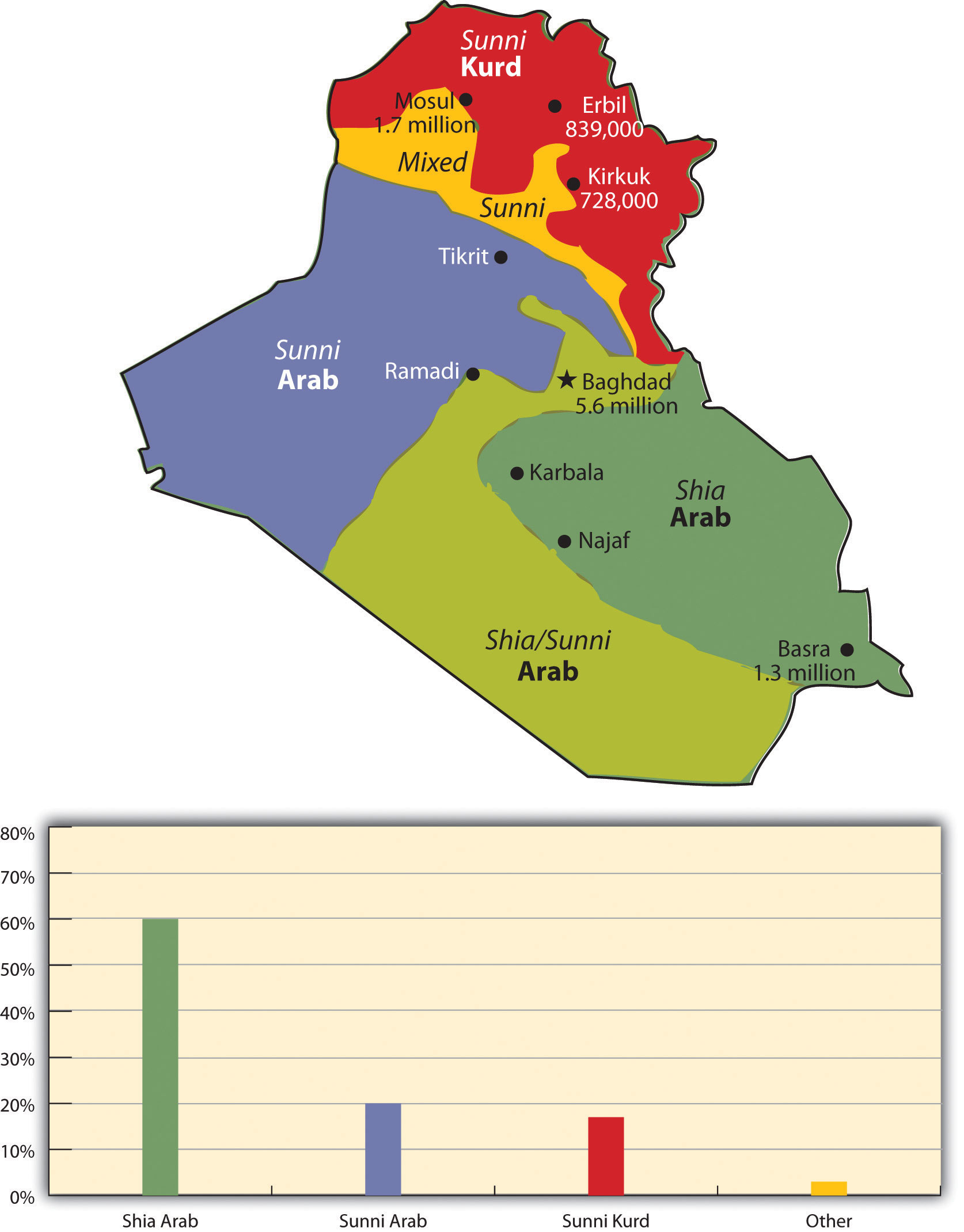
Lately, I have been turning on CNN for coverage of the Middle East, and found them to be well, fair and balanced.  Anderson Cooper asks tough questions of guests and has a variety of them.  I was surprised at how well one guest summarized the roots of the conflict.  Essentially, the Shia majority under Maliki was abusive of its power towards the Sunnis.  (Of course, the Sunnis were favored by Saddam who brutalized the Shiites, but whatever.)  This has given rise to ethnic hatreds that fueled support for ISIS. ISIS claims to represent a swath of Arabic speaking peoples in the western Mesopotamia, parts of Iraq and Syria.  These people feel more loyalty to tribe than to the imagined country named Iraq.  Of course, I am not the first one to notice this. Writing in the CSM in 2007, O'Brien Browne laid out the case for separate nations to be carved out of Iraq.
Mesopotamia, as the region that includes Iraq was called until recently, had never been a "country" or "nation" in the modern senses of these words. The wise and largely benign rulers of the Ottoman Empire, who reigned over this land for centuries, realized that no outside force could ever rule this area by foisting preconceived notions of nationhood upon the population, whose loyalties lay with family, tribe, linguistic grouping, and religious orientation.
Unfortunately, when historic mistakes must be corrected, but the only means of correction is armed conflict, the most violent and ruthless group will come to the fore to lead the charge.  This is how the Bolsheviks came to power in Russia, to cite one well-known example. ISIS is nothing if not ruthless and bloodthirsty, but that will be their undoing as the administration of the apparatus of statehood requires skills other pure ideology.  Further, they have made too many enemies.  The governments of Syria, Iraq and Turkey are all going to work against them, as well as the Kurdish regional government.

Meanwhile, Browne saw the break up of Yugoslavia as instructive for what might need to happen in Iraq.
Unfortunately, this meant that wars had to be fought. Though vicious, cruel, and bloody, this process was vital. Its beneficial results can be seen on a modern map of the region: New countries such as Croatia have the telltale odd shape and wiggly lines of older, established, stable countries. Gone are those artificial border lines, the unreal trappings of a federation that should never have existed. Gone, for the most part, too, is the explosive anger that exists when ethnic groups are unwillingly thrown together. Instead, although Serbs, Croats, and the other groups do not love one another, they can now live alongside one another in relative harmony. Where this is not the case, as in Kosovo, ethnic tensions continue to bubble.
I think that ISIS has made too many enemies to survive, but the idea that the Sunnis of western Mesopotamia should have their own state will outlast these vile genocidal madmen.  There is no constitution capable of imposing trust between peoples riven by religious and ethnic conflict.

Some maps to help sort it out:  Iraq by ethnicity/religion source: Royal Burglee's Flatworld Knowledge web site:


Here is the situation today, according to a map on Wikipedia titled "Syria and Iraq 2014-onward War map" by Haghal Jagul - Own workTemplate:Syrian civil war detailed mapTemplate:Iraq war detailed map. Licensed under CC0 via Wikimedia Commons.


Map of Syrian Civil War and the Iraqi insurgency
   Controlled by Syrian rebels 
   Controlled by Syrian government 
   Controlled by Iraqi government 
   Controlled by the Islamic State in Iraq and the Levant (ISIS) 
   Controlled by Syrian Kurds 
   Controlled by Iraqi Kurds 
   Controlled by the Qaraqosh Protection Committee