Showing posts with label Chargers. Show all posts

Thursday, January 12, 2017

Yawn - Chargers to Leave San Diego

The impending move of the Chargers to Los Angeles has left with me with a so what feeling.  I lost emotional connection with them a few years back.  I had no intention of supporting another hold-up of the city finances.

The only silver lining is that maybe we will have incentive to figure out how to make stadiums profitable without football teams. If that problem could be solved, we could build stadiums and not get soaked on the deal.  

So long.  And good luck playing second fiddle to the Rams in LA. 

Monday, July 6, 2015

San Diego vs. Chargers - All Over But the Divorce Decree

Mayor Faulconer appears to have played a weak hand badly with regards to negotiations with the Chargers, if his goal was to keep the Chargers in San Diego.  Jeffrey Siniard has been covering the situation at www.boltsfromtheblue.com:
Mistakes made by the City of San Diego:
1. Mayor Faulconer and his staff got in over their heads the moment they didn't realize how much pressure the Chargers were under to make a deal, and assumed it was primarily an attempt by the Chargers to manufacture leverage.
2. A better understanding of the situation by Falconer and his staff could have led to an earlier City/County partnership, earlier hiring of negotiating experts, who then could've worked with CSAG to produce a polished offer in shorter time.
3. Instead of ignoring all of the noise coming from the Chargers, the City has instead chosen to respond in kind, which abets the Chargers "We have to Los Angeles" narrative.
But I also agree with Siniard said earlier in the same article, Falulconer's main goal seems to be to avoid blame should the Chargers leave town.  Charger attorney Fabiani's overheated rhetoric serves that end so well, it makes you wonder if it isn't a conspiracy.

In a more recent post Siniard argues that the December election is a sure loser for the City:
- There is no solution the Chargers and/or the NFL will accept in San Diego for 2015. Stop trying to come up with one. Much as people want the Chargers to accept San Diego's idea, they are a private business and are under no obligation to accept it.
- All of the options presented by San Diego for getting around the California Environmental Quality Act (CEQA) carry a significant degree of risk from a successful lawsuit, or take too long to complete for a vote in 2015.
- Furthermore, no deal in San Diego can beat the deal the Chargers have put together with the Raiders in Carson. Until that option disappears, there's no reason for the Chargers and/or Raiders to negotiate in good faith with their home markets. The Chargers and Raiders are going to see how Los Angeles plays out this year. They'd be stupid to do otherwise.
I have argued that there is no way the Chargers can remain in town, because we will never be able to compete with Los Angeles in terms of what the city gives away to the team.  Siniard take the view that the only way to keep the Chargers here is to apply pressure on the NFL. But he is clear that it only buys some time for an election to be held during "prime time" that would have a chance of passing a plan that would satisfy the Chargers.  Too many ifs, in my opinion; better to just let the team walk rather than divert leadership attention from other pressing problems.


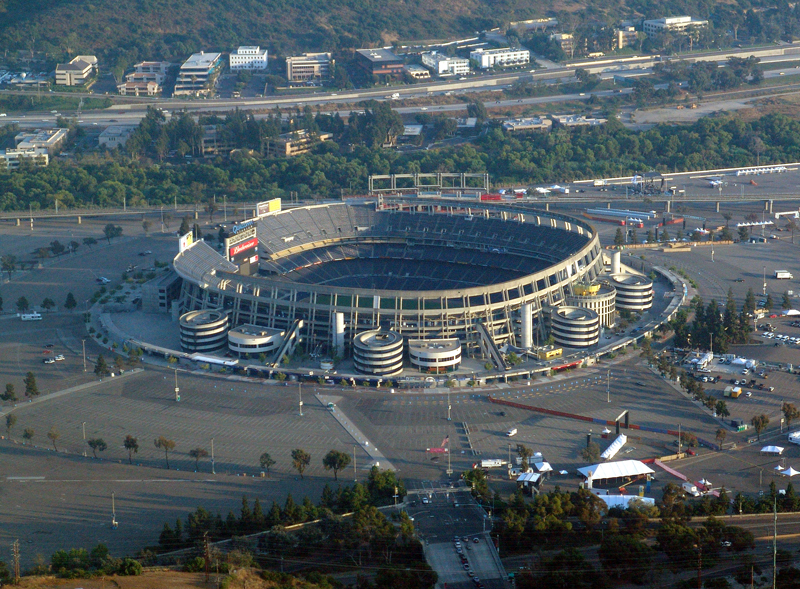
Qualcomm Stadium By Intersofia at en.wikipedia [CC BY-SA 2.0], from Wikimedia Commons

What You Should Be Reading:

  • The Voice of San Diego, because even if they are left of center, they break important stories.  It's called journalism and the national press should take notice.  Going after Dumanis in today's edition with more great investigative work

Friday, March 6, 2015

The Chargers Must Leave San Diego

Qualcomm Stadium By Intersofia at en.wikipedia [CC BY-SA 2.0], from Wikimedia Commons

As long as the voters of San Diego are willing to punish politicians for subsidizing a new Chargers stadium, or as long as the law is interpreted that such subsidies require a public vote, there is no way that the Chargers can remain in San Diego for much longer. Numerous studies have shown that the value of a football stadium to a city is never more than the amount of money plowed into subsidies, so there will never be a viable economic argument for a new stadium, and I think San Diegans understand that. See Pacific-Standard for a great summary of the issue in general in America.
. . . from 2001 to 2010, 50 new sports facilities were opened, receiving $130 million more, on average, than those opened in the preceding decade. (All figures from Long’s book adjusted for 2010 dollars.) In the 1990s, the average public cost for a new facility was estimated at $142 million, but by the end of the 2000s, that figure jumped to $241 million: an increase of 70 percent.
. . .
Due to these oversights, Long calculates that economists have been underestimating public subsidies for sports facilities by 25 percent, raising the figure to $259 million per facility in operation during the 2010 season.
This only leaves emotional arguments about the value to the city of being in the "big leagues."  However,  even with the Chargers threatening to leave, the latest polls indicate that the public is unwilling to subsidize the team to stay in San Diego, with 54% disapproving of using tax dollars to keep the Chargers.

However, the situation is also unfair from the Spanos family's viewpoint. Other cities are willing to subsidize their football teams with money for stadiums, so San Diegans attitude puts the Spanos' Charger team at a competitive disadvantage. They have to compete against teams in larger markets who are playing on subsidized ballfields. The interest on loans to build a stadium is money not available to pay players salaries.  If the Chargers are a business, then they would be crazy not to look to move to a location where subsidies drive down their costs.  Ultimately, the business with the higher cost goes bust.  In the NFL, this would mean never being in contention and slowly losing your fan base.  Also, if the Chargers aren't going to receive subsidies, then moving to a larger market and sharing the costs of a stadium with the Raiders in Carson is still better than footing the bill alone in San Diego.

The real problem is that politicians in most other states and cities are willing to ignore public opinion and provide tax payer funding to professional sports franchises.  They do so, even when the public votes against ballot measures, like in Pittsburgh.  In such an environment, the only way to win is not to play the game.  But it means the Chargers have to go.