Showing posts sorted by relevance for query hauser's law. Sort by date Show all posts

Friday, November 26, 2010

Hauser's Law and the Deficit

Today's WSJ has more insight on Hauser's Law, on which I have previously posted. In summary, we have seen empirically over the last 80 years that regardless of top marginal tax rates, the federal government's tax receipts as a share of GDP always falls just short of 20%.


This evidence is important to consider when trying to reduce the deficit. It becomes clear that raising marginal tax rates will not increase federal tax revenue, so we shouldn't even try. Further, evidence from other countries is that the efficiency of the tax code matters to growth. The Tea Party should be supporting a simpler and fairer tax code, along the lines of the compromise that Reagan reached with Democrats in the 1980s.

Eliminating all manner of "tax breaks" for businesses and individuals will be part of the difficult work ahead. Special interests, and I include myself as a homeowner, enjoy these benefits. But if the structure were simpler, with lower rates, we would all be better off. Further, eliminating complexity in the tax code reduces corruption and the appearance of corruption as fewer interest groups have the ability to gain benefits through the code. A simpler tax code also directs resources based solely on economic benefit, not tax consideration. A simpler tax code also eliminates the waste of businesses time and money in trying to "game the system," freeing management time to focus on improving profits.

From Hauser's article on why higher marginal rates (which are always coupled with complexity) work against the economy:

Higher taxes discourage the "animal spirits" of entrepreneurship. When tax rates are raised, taxpayers are encouraged to shift, hide and underreport income. Taxpayers divert their effort from pro-growth productive investments to seeking tax shelters, tax havens and tax exempt investments. This behavior tends to dampen economic growth and job creation. Lower taxes increase the incentives to work, produce, save and invest, thereby encouraging capital formation and jobs. Taxpayers have less incentive to shelter and shift income.
Tackling the deficit means reducing spending and increasing federal tax receipts. But we can only do so by growing the real economy. A simpler tax code with lower marginal rates is consistent with Tea Party principles of a less intrusive federal government. Further, the growth in tax revenues that such policies cause help reduce the deficit.

Wednesday, June 30, 2010

Debt Without End?

The most recent report on the federal debt outlook from the Congressional Budget Office doesn't paint a pretty picture. From the CBO's blog (who knew?):

Recently, the federal government has been recording the largest budget deficits, as a share of the economy, since the end of World War II. As a result of those deficits, the amount of federal debt held by the public has surged. At the end of 2008, that debt equaled 40 percent of the nation’s annual economic output (as measured by gross domestic product, or GDP), a little above the 40-year average of 36 percent. Since then, large budget deficits have caused debt held by the public to shoot upward; CBO projects that federal debt will reach 62 percent of GDP by the end of this year—the highest percentage since shortly after World War II.

But that's only the start. The Economist has some analysis on likely scenarios and publishes this chart:


The CBO blog has an explanation for the shape of these curves:

The budget outlook is much bleaker under the alternative fiscal scenario, which incorporates several changes to current law that are widely expected to occur or that would modify some provisions of law that might be difficult to sustain for a long period. In this scenario, CBO assumed that Medicare’s payment rates for physicians would gradually increase (which would not happen under current law) and that several policies enacted in the recent health care legislation that would restrain growth in health care spending would not continue in effect after 2020.
Note how the increase in spending in the long term is due to medical spending by the federal government. This is the reason that Obamacare is so pernicious. For all the reasons that we have detailed previously (straitjacket on free enterprise, reduced competition, increased demand due to subsidies) spending on health care by the federal government will inevitably increase.

Further, there are other reasons to be believe that tax revenues will be flat in the long run, as shown in the chart above, regardless of tax law changes. I have previously commented on Hauser's law, which is an empirical observation that federal tax receipts will never rise above 20%. Recently found the graph that shows this:


The math of our situation is unavoidable. Under the current tax system, we will not raise significantly more revenue, but the cost of government will inevitably rise. To answer the title question, of course this debt will end, because it is unsustainable. If the Greeks can figure this out, so can we, the sooner, the better.

Thursday, June 23, 2011

Tax Increases and the Debt Limit Debate

For most of my life, I have opposed tax increases on the theory that the government already takes too much of the people's hard earned wealth. During the Bush administration, I started to waiver in that position. I saw the huge deficits as threats to our long term economic health, and thought that tax increases might be the necessary price for past profligacy. We see in the example of Greece today, where the results of excessive government largesse, along with Enron style accounting leads to. From today's Reuters article:
Greeks seething after two years of belt-tightening reacted in anger Thursday against a new round of tax rises and spending cuts worth some 3.8 billion euros which they said would again hit honest taxpayers hardest.

Of course they will. KT at the Scratching Post felt that higher taxes were inevitable because the math for achieving balanced budgets through spending cuts alone seems too daunting. So there I was, wavering on a lifetime political position. But then I stumbled across Hauser's Law, on which I have posted extensively and rediscovered my inner supply-sider.

Which brings me to the debt ceiling debate. Supposedly only Boehner, Obama, and Reid are left to negotiate the conditions under which the debt limit might be raised. Supposedly, John Kyl and Eric Cantor have left the negotiations, frustrated that the Democrats won't budge on the issue of tax increases. Not having followed the issue for a while, I was heartened to see that the Republicans are using the debt ceiling debate to leverage further budget cuts. My concern is that Boehner is now left as the only negotiator on the Republican side.

The principled position on increasing federal revenue is to maintain low marginal tax rates, with few, if any deductions. This has worked consistently in the past. Given the impact of Hauser's law and need for growth in the economy, no tax increase should be considered in this debate. So far, I believe that Boehner has played his weak hand with great skill, but this is his toughest test to date. I hope he hangs tough, the last thing we need are job killing tax increases.

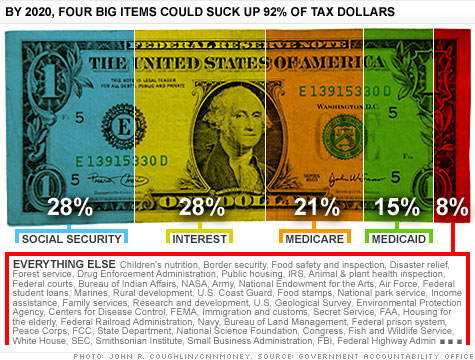
However, nothing in my reading suggests that either party is ready to deal with entitlements. As Tea Partyers, we need to state our plans to deal with entitlements, because that's where most of the federal budget money goes. Some believe that if we just cut taxes and regulation, the economy would grow its way out of our crisis. While growth would ease the pain, it won't erase it completely, unless growth gets to record setting levels. The only way our economy can grow at the rates needed to maintain entitlements would require a massive influx of new immigrants to raise the labor participation rate of our aging work force. Are we in the Tea Party ready to endorse large numbers of engineers, scientists and technicians emigrating from the likes of China and India? I know I am, but I have seen little discussion of this approach elsewhere. Exit question, what should the official Tea Party position on Social Security, Medicare and Medicaid be?

Wednesday, March 20, 2013

Picture of the Day


Thinking things through, it seems odd that Democrats are the ones fighting against entitlement reform and Republicans the only ones pushing it.  If you accept that tax receipts are limited as a percent of the economy, no matter what tax policy you adopt (see Hauser's Law chart), then our current entitlement structure will eventually crush the ability of the feds to spend on anything but entitlements.  Meanwhile, Republicans keep proposing reforms which might actually save the rest of the federal government.  Go figure.  The Heritage Foundation has another cool graphic to illustrate these ideas differently:


I don't believe this picture accurately portrays the acceleration of the net interest that will eventually occur, since artificially low interests are not indefinitely sustainable.   The real issue is that the federal government is going to quickly become unaffordable.

Monday, January 3, 2011

Expanding Deficit - Revenue or Spending Problem? UPDATED

Steve commented on my BWD post that the reason that the federal deficit is growing is due to decreasing federal revenue. Because of Hauser's law, I opined that it must be due to rising spending. I pulled up this chart from the Heritage Foundation to check the facts. What do you think?

Fed Spending Growing Faster Than Fed Revenue

In case I lose the link:


However, I am a little mystified at the rate at which the debt is climbing, it does not appear to be fully explained by either the rise in spending nor the fall in revenue. The deficit is climbing at a rate of $2 trillion per year, where as the gap between revenue and debt only recently peaked at $1.5 trillion per year. From CBS News:


Anyone who knows the answer to this mystery, I am anxious to hear from you.

UPDATE

W.C. points out in the comments that I am not the first person to have noticed that the debt is growing faster than the deficit would suggest, pointing out that Zero Hedge and Denninger had commented, without concise conclusion, there seems to be a general consensus that the difference is accounting gimmicks. Adam Freund suggests that it is a failure to account for interest on the debt. Thanks for the further insight.

Monday, June 7, 2010

Quote of the Week

Comes from Arthur Laffer in today's Wall Street Journal:

It has always amazed me how tax cuts don't work until they take effect.
I know that KT has talked about paying enough in taxes to cover our deficits, but there are solid arguments to be made on the limits of raising revenue through the income tax. Hauser's law is an observation that, despite a variety of tax rates imposed since World War II, the percent of federal income tax receipts as a share of GDP has held remarkably steady at 19.5%. In practice, this means that the federal government should set tax rates in a way that encourages investment and saving. Only by growing GDP does federal income tax receipts grow.


I allow that other forms of taxation bring in revenue to the feds, but that is not the point of the current discussion. The combination of tax increases set to take effect in 2011 almost guarantee Obama a one term presidency, don't take my word for it, here is what tax experts H&R Block have to say:

Beginning in 2011, tax rates in effect prior to 2001 spring back into effect. The top income tax rate returns to 39.6 percent, and the special low 10 percent bracket is eliminated. Whether this will actually happen will be at the heart of a spirited battle in Congress.

Estate Tax Revived

For individuals dying after 2011, the federal estate tax returns with a $1,000,000 exemption and a 50 percent maximum rate. This assumes that Congress allows the estate tax to disappear in 2011, which is unlikely.

Increase in Capital Gains and Dividend Tax Rates

The tax rate reductions for long-term capital gains and dividends is scheduled to expire this year.

In 2011, the maximum long-term capital gains tax rate goes back up to 20 percent from 15 percent. A lower 10 percent tax rate is used by individuals who are in the 15 percent tax bracket. Their long-term capital gains had been tax-free since 2008.
In 2011, dividend income (other than capital gain distributions from mutual funds) is taxed as ordinary income at your highest marginal tax rate.

Child Tax Credit

The credit of $1,000 per eligible child reverts to $500 after 2011. After 2011, none of the child tax credit will be refundable to taxpayers unless their earned income is more than $12,550. This is one of the many Bush tax cuts currently scheduled to expire after 2011.

Payroll Tax Credit

Starting in 2011, the partial credit for payroll taxes paid is no longer available.

Decreased Section 179 Expense Deduction

Taxpayers who purchase qualifying business property may elect to deduct the cost of the property (new or used) in the year that it is placed in service. This is referred to as a Section 179 deduction. In 2010 and 2011, the maximum amount of property that may be taken as a Section 179 deduction is $125,000, as indexed for inflation. In 2011 and future years, the maximum deduction drops to $25,000.

College Savings Plans

Beginning in 2011, 529 Plans can no longer be tapped tax-free to pay for a computer or Internet access.

Tax Credit for College Tuition

The Hope credit is again limited to the first two years of college and is capped at $1,800. None of the credit is refundable if it is more than your regular income tax liability.

Earned Income Tax Credit (EITC)

Temporary increases in the Earned Income Tax Credit for filers with three or more children and the higher income levels for the phaseout of the credit are repealed.


The blog Emptysuit has a nice summary as well. The collective weight of these marginal tax rate increases will inevitably kill any economic recovery.