You can complain about the way it did its job or what it accomplished, but by passing a continuing resolution for the rest of the year that included specific direction to agencies on spending priorities, the Congress has finally done its job after a four abdication, mostly by Democrats in the Senate, in passing a budget.
The other interesting note is that the liberty movement seems to be winning the war, despite losing many battles. Lower spending based on sequestration has locked in. No new taxes were proposed. The government is on a trajectory to spend less. You could argue that without entitlement reform, these spending reductions will be overwhelmed by entitlement spending increases. I have made that argument myself. But I believe this sets the stage for the Congress to start believing it can restore its rightful place in our Constitutional order, and perhaps craft a deal on entitlements as well. I guarantee that if that happens, I won't be happy, and my readers won't be happy. The left won't be happy either, but the Republic will muddle through and the dynamism of our economy will cover a lot of sins in the capital.
I am one of the employees who still might face a furlough, so I have followed the budget closely. It was interesting to see the Congress reassert its authority, by changing some spending priorities, setting limits on flexibility, and in general restoring some of its authority. I still don't know if I will be furloughed, but if I am, it looks to be fewer unpaid days off and I will know that it wasn't solely because the administration unilaterally made my job a bargaining pawn with the Congress. Some of the bargaining may still happen, but in a manner more consistent with the Founder's intent.
Showing posts with label federal budget. Show all posts
Showing posts with label federal budget. Show all posts
Friday, March 22, 2013


Wednesday, March 20, 2013
Picture of the Day
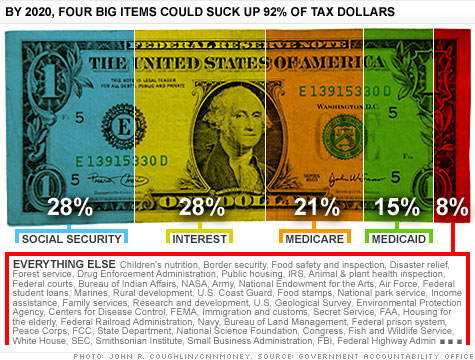
Thinking things through, it seems odd that Democrats are the ones fighting against entitlement reform and Republicans the only ones pushing it. If you accept that tax receipts are limited as a percent of the economy, no matter what tax policy you adopt (see Hauser's Law chart), then our current entitlement structure will eventually crush the ability of the feds to spend on anything but entitlements. Meanwhile, Republicans keep proposing reforms which might actually save the rest of the federal government. Go figure. The Heritage Foundation has another cool graphic to illustrate these ideas differently:

I don't believe this picture accurately portrays the acceleration of the net interest that will eventually occur, since artificially low interests are not indefinitely sustainable. The real issue is that the federal government is going to quickly become unaffordable.
Thursday, November 29, 2012
Deficit Agenda for Obama's Second Term
Obama's re-election is not the end of the world, studies of ancient Mayan calendars notwithstanding. The Republicans have an opportunity to get their act together in ways that will both improve the country and put themselves in a better position to win future elections.
The so-called fiscal cliff is the first opportunity to shape future policy to their favor. The Democrats are going to want taxes now in exchange for spending cuts later, which will never come. The Republicans can easily outflank on this issue. Offer some revenue increases that also simplify the tax code, but demand spending cuts now. The following graphic shows why.
 Graphic from Senate Budget Committee, with modifications by author.
A majority, but not all of the problem, with the federal budget's current unsustainable path accrues to spending that is too high by historical standards. The debate on the issue of the debt has trended towards the position that the deficit is high and unsustainable and away from Paul Krugman's fantasy that we shouldn't worry and should be spending more money. Republicans should take the position that spending cuts are needed now, and that simplifying the tax code by eliminating so many credits and deductions will increase revenue by increasing growth as well as from the additional revenue from fewer loopholes. Benefits of this approach:
1. Appearing "reasonable" by putting revenue on the tabe.
2. Moving towards tax code simplification.
3. Setting the stage to demand spending cuts now as a result.
No spending cuts = no deal.
I think the fiscal cliff has the potential to harm the economy due to the massive income tax rate increases coupled with the payroll tax being restored to its historical trend, all at once. The only silver lining would be the automatic cuts to the federal budget.
My next post will look at immigration reform. Blogging will continue to be sporadic until work and school calm down.
The so-called fiscal cliff is the first opportunity to shape future policy to their favor. The Democrats are going to want taxes now in exchange for spending cuts later, which will never come. The Republicans can easily outflank on this issue. Offer some revenue increases that also simplify the tax code, but demand spending cuts now. The following graphic shows why.
 Graphic from Senate Budget Committee, with modifications by author.
A majority, but not all of the problem, with the federal budget's current unsustainable path accrues to spending that is too high by historical standards. The debate on the issue of the debt has trended towards the position that the deficit is high and unsustainable and away from Paul Krugman's fantasy that we shouldn't worry and should be spending more money. Republicans should take the position that spending cuts are needed now, and that simplifying the tax code by eliminating so many credits and deductions will increase revenue by increasing growth as well as from the additional revenue from fewer loopholes. Benefits of this approach:
1. Appearing "reasonable" by putting revenue on the tabe.
2. Moving towards tax code simplification.
3. Setting the stage to demand spending cuts now as a result.
No spending cuts = no deal.
I think the fiscal cliff has the potential to harm the economy due to the massive income tax rate increases coupled with the payroll tax being restored to its historical trend, all at once. The only silver lining would be the automatic cuts to the federal budget.
My next post will look at immigration reform. Blogging will continue to be sporadic until work and school calm down.
Sunday, July 31, 2011
John Stossel's Chainsaw Budget
 Before I get to an interesting take on the budget, I wanted to briefly comment on the state of play on the debt ceiling. Looking at what little information that is available on the debt ceiling deal proposed by McConnell, I am pretty certain that no one will be happy. Failing to make structural reforms to medicare and social security will be a long term disaster, along with back loading the budget cuts. From the AP:
Big cuts in government spending would be phased in over a decade. Thousands of programs — the Park Service, Internal Revenue Service and Labor Department accounts among them — could be trimmed to levels last seen years ago.
No Social Security or Medicare benefits would be cut, but the programs could be scoured for other savings. Taxes would be unlikely to rise.
Meanwhile John Stossel says that he can balance the budget next year. His proposals are too radical to pass, but I think they form a decent starting point to allow the tea party movement to point to specific things we would support. Here are some highlights from his web site along with specifics.
- Reduce Social Security outlays as follows ($85.7 billion per year)
- Raise the normal retirement age
- Cut Social Security disability program by 10%
- Means test social security $170 billion per year
- Eliminate Department of Education $106 billion per year.
- Medicare/Medicaid reform $441 billion annually
- Make medicaid a matching block grant program that caps the amount a state receives.
- Eliminate Dept of Transportation - $84.8 billion
- Cut defense spending by 2/3 - $475 billion (Yes, I am opposed to such a deep cut in defense, but in fairness, we should acknowledge that it is a big part of the budget.)
- Cut federal civilian compensation costs by 10% - $29.6 billion
- Eliminate Fannie/Freddie Subsidies - $14 billion
Thursday, April 14, 2011
Pat Buchanan Nails It
In an article entitled Obama Blows Up the Bridge, Pat Buchanan nails the many reasons for deep seated antipathy to the President's speech on the budget.
"Rather than building bridges, he's poisoning wells," said Rep. Paul Ryan, after listening to Barack Obama's scathing attack on his deficit-reduction plan as a shredding of America's social contract with the elderly and poor.There you have it, the President shows not a shred of Clinton's triangulation. Say what you will about the forty-second President, his triangulation produced welfare reform, an historic free trade agreement and balanced budgets. Obama has yet to get significant Republican support for a single initiative. He lacks serious purpose and is unable to recognize that his positions took a beating in November. Further success will elude him.
Ryan is right. Yet, with Obama's partisan savagery, virtually calling the GOP plan immoral, we have clarity.
There will be no grand bipartisan bargain on taxes and spending.
The two parties on Capitol Hill and the president will not be coming together to solve the gravest financial and fiscal crisis America has faced since the Great Depression. Between them today is a high wall and a deep ditch.
The heart of the Ryan plan is to turn Medicaid into block grants to the states, so each can decide for itself how best to use the funds, and to convert Medicare into a program where the U.S. government would provide citizens with the funds and freedom to chose whatever health insurance they wished to buy.
Obama denounced both.
Wednesday, April 6, 2011
The Answer is Obvious

The question is, "Which plan do you prefer?" Of course, it is not really a contest. The President's budget, submitted to the Congress last January was a fatuous exercise in futility and epitomized his total abandonment of any pretense to leadership.
Dean claims Paul Ryan for his generation as a Great American a member of a cohort destined to save the country. Hard to disagree.
Link to article to WSJ source of material here.
Wednesday, March 2, 2011
Obama on the Run - Dispatches Biden to Negotiate

The temporary spending measure pushed through was passed by the Senate on a 91-9 vote today, included $4 billion in spending cuts, one week after Harry Reid had rejected such a plan. Meanwhile, the President is appearing to concede that his weak budget plan to merely freeze spending is going nowhere.
Largely a spectator so far, President Barack Obama dispatched his vice president to initiate negotiations on a broader, longer-term spending bill and find "common ground" with GOP leaders determined to cut tens of billions of dollars more and undo much of his agenda. He conceded in advance that any deal on a government budget covering the next seven months will feature cuts . . . The upcoming talks, to be led by Vice President Joe Biden, promise to be far more difficult.Meanwhile, earmarks have all but disappeared from the budget debate. This is a major victory for John Boehner and Tom Coburn, in my opinion. I wasn't previously aware that Boehner had made battling earmarks a cornerstone of his career. The absence of earmarks is making it easier to agree on spending cuts according to the linked article. Hooray! Here's why:
No wonder Coburn called earmarks the "gateway drug" to run away spending.Top members of the Appropriations Committee might, for instance, grant a lawmaker’s request for a few million dollars for an important project back home. That lawmaker would then be obligated to support the entire multibillion-dollar bill despite possible reservations. Woe to the person who gets an earmark and then opposes the bill; chances for a future earmark would be somewhere between zero and none.
“You get millions for an earmark and end up voting for billions of dollars that you may oppose,” said Steve Ellis, a vice president at Taxpayers for Common Sense, a government watchdog group.

Tuesday, March 1, 2011
Small Progress on the Federal Budget
 Not near what we wanted, which would be $60+ billion in cuts this fiscal year, but John Boehner got the Senate and Obama to blink by forcing $4 billion in cuts as the price for 10 more days funding of the federal government.
I am certain there will be complaints, but if we can get $4 billion in cuts every 10 days we are on a pace to exceed $70 billion for the rest of the year. The other great aspect of the debate is that it has the Democrats playing defense. Not a single new program is being offered, no new spending is being contemplated. The only question is how much can be cut. In the linked article, its clear that the Democrats are in disarray over how to handle the calls for budget cuts. They know it helps Republicans, but they can't bring themselves to sign up.
I think that American business would start investing and growing again if they could be assured that there would be no further tax increases and that the federal governments role would be stabilized. When you think of the Clinton and Reagan expansions, they were made possible due to a stabilization in the role of government, resulting in a predictable business climate. Clinton had help from Republican majorities, but when you think of the accomplishments of his administration, NAFTA, Welfare Reform, and a balanced budget, you would have thought we had elected a Republican to the White House.
I say, keep up the good work Speaker Boehner. $4 billion in cuts every ten days is the new gold standard.
Subscribe to:
Posts (Atom)


 Posts
Posts

