Showing posts with label public employee unions. Show all posts

Tuesday, December 3, 2013

Public Employee Pension Roundup - Illinois, Detroit Update

Here is a summary of key areas in the fight to prevent state and local public employee pensions from bankrupting governments.

Detroit. Judge Stephen Rhodes will rule today at 10:00 a.m. (EST) on whether the city is eligible to enter bankruptcy.  From the LATimes. Most legal experts expect Rhodes to declare that Detroit is eligible for bankruptcy protection.  A ruling to enter bankruptcy would give emergency city manager Kevyn Orr leverage to bargain with unions over pension reductions or to make unilateral changes.  Whether such changes would be constitutional would be decided later.
UPDATE:  The NYTimes is reporting that Detroit is insolvent and eligible for bankruptcy:
Judge Steven W. Rhodes of the United States Bankruptcy Court, found that Detroit was insolvent and that the pension checks of retirees could be cut during a bankruptcy proceeding, a crucial part of his decision
I had not expected that a ruling on pensions to be part of the judge's ruling.  USAToday has some amazing facts about Detroit's situation including the fact that it has three times as many retirees as workers.

Illinois. As I discussed earlier, the state is poised to vote on huge pension reform and the outcome is in doubt.  A vote is expected in both the state House and Senate, also today.  The outcome is clouded because Republicans who normally would vote for such a measure will be helping the state's Democratic governor.  My answer, be known as the party of principle, it works better for you in the long run.  Meanwhile, some Democrats will have to vote against the unions for this to pass.    More detail on the plan:
About $90 billion to $100 billion of that savings is expected to come out of the wallets of state workers, teachers outside Chicago and public university employees. The other $60 billion to $70 billion in savings is expected to come from the state owing less as it seeks to pay down the pension debt sooner — a move akin to a homeowner saving money by paying down the principal on a mortgage more quickly.
UPDATE:  The WSJ is reporting that pension reform has passed the Illinois state legislature.  The Chicago Tribune reported that the House voted 62-53 in favor and the state Senate passed with a 30-24 vote.  In reviewing the details in the Tribune article, I am inclined to agree with Brian Brady, frequent SD Rostra commenter and blogger, that the reform doesn't go far enough.


San Diego. Proposition B remains held up in administrative limbo by the California Public Employment Relations Board (PERB), no relation to Bob Filner.  Craig Gustafson reports in the U-T that the key cost saving measure of Proposition B has been implemented.
. . . the city and its unions reached a deal earlier this year on a five-year freeze on the pensionable pay of current city workers, a provision in the ballot measure that is projected to save the city nearly $1 billion over the next three decades. By agreeing to terms, the city has locked in those savings even if Proposition B is later found to be illegal.
Unfortunately, the city may have to wait until April 2015 to get a ruling.  Implementing remaining pieces of the proposition may become an issue in the mayoral campaign. Meanwhile, the city of San Diego chose to settle a lawsuit where the city tried to get the city employees to be responsible for half of any shortfall in the pension funds investment rate.  I am concerned, as is the U-T editorial board, that this signals a lack of willingness on the city council to tackle tough pension issue.

California. The mayor of San Jose, Chuck Reed, is attempting to put pension reform on the state ballot in 2014.  Reed is a Democrat, like Governor Pat Quinn of Illinois.  The Pension Reform Act of 2014 would give cities more flexibility in changing pension retiree health care rules for future retirees.  The public employee unions are actively opposing the plan of course.
“What they’re trying to do is overturn decades of case law, Supreme Court decisions and change the California constitution to allow public employers to either change, cut or eliminate public employees’ pensions in the middle of their career,” said Dave Low, executive director of the California School Employees Association and chairman of Californians for Retirement Security, a coalition of public employees and retirees.
Exactly.  Of course we need to change decades of case law because these retirement benefits are unsustainable if we are to have government perform any function at all.

Rhode Island. In the mostly Democratic state of Rhode Island, the legislature passed pension reform in 2011 that included a temporary halt in cost of living increases and moving part of the retirement to a 401(k) style plan.  From the state's web site:
The Rhode Island Retirement Security Act of 2011 as Amended includes language that: 
  • Suspends  new  cost‐of‐living  adjustments  (COLAs)  to  retirees’  benefits  until  the system is better funded but provides for an intermittent COLA every five years until 80% funded.
  • Moves all but public safety employees to hybrid pension plans.  
  • Increases minimum retirement age for most employees not already eligible to retire.
  • Preserves accrued benefits earned through June 30, 2012. 
  • Begins to address independent local plan solvency issues.
Recent complaints about the investment strategy pursued by the state's treasurer do nothing to change the basic impetus for pension reform.  There are allegations by a long time financial industry critic, "Ted" Siedel on inappropriate investing in hedge funds that result in hefty Wall Street fees. (Hedge funds received over half of the fees paid out by the pension fund last year.) However, 401(k) style pensions could reduce the opportunity for abuse, if employees are given the opportunity to choose their own fund in which to invest.  More important to note for supporters of pension reform, the legal struggle over pension reform in Rhode Island continue two years later, with no end in sight.

Lesson learned: You have to be in this fight for the long haul.

What You Should Be Reading


Friday, November 29, 2013

When Pension Reform Goes Bipartisan

Eventually the mathematical results of under-funding ever more generous pension benefits for state and local employees becomes a problem for Democrats too.  Illinois legislators are expected to vote this week on pension reform that would pare back pension benefits in three important ways.
  • Reducing cost of living increases.
  • Increases retirement age.
  • Capping the salary amount available for pension calculations.
There are few other means short of bankruptcy that can be used to reduce pension obligations.  However, Illinois has rejected attempts at pension reform before, so the path to success in the legislature is not certain.  Of course, the state employee unions are waiting to sue if a pension reform measure passes.  This is one of the most important long term issues for state and local government.  Without pension reform here in California and San Diego, the state and city governments will eventually have no money for basic services.  Rahm Emmanuel, not known for his tea party rhetoric, made the same point.
The [state] agreement also is expected to provide a template for Chicago Mayor Rahm Emanuel to follow for his city, which for years has paid far less into its retirement system than needed to keep it solvent. City payments to local pension funds are set to more than double to nearly $1.1 billion starting in 2015. Mr. Emanuel has warned that if changes aren't made, the city will face a combination of property-tax increases and cuts in services, equating the scheduled increase to the cost of having 4,300 police officers on the street.
It is important to note how a deal was reached among Illinois legislative leaders.
Labor officials excluded from the talks found out about the eventual Wednesday breakthrough from reporters. 
. . .   
“I think it’s going to be difficult,” said Sen. Linda Holmes, D-Aurora, a member of the pension conference committee and supporter of labor’s arguments in pension talks. “I’m uncomfortable they didn’t have a seat at the table when they’re the people who’ll be impacted by this.”
If Democratic politicians feel the need to exclude labor from pension reform talks, then the situation must certainly be dire.  Illinois is paying a 2% premium on its bonds while pension reform remains unresolved. (California and Michigan are paying about a half-percent premium, source: WSJ.)  

This is one of the key issues of our day, because the proper functioning of government is being put at risk by the expense of public employee pensions.  I support Kevin Faulconer for mayor of San Diego, primarily because I am convinced he can be trusted to continue the fight to reform pensions that was approved by voters under Proposition B.  Alvarez' response on this issue does not "inspire confidence" as a U-T editorial put it.  I would prefer to deal with our pension problems before they become a crisis like Illinois' and Chicago's.

What You Should Be Reading

  • Victor Davis Hanson provides the most complete compendium of Obama-fail I have seen assembled in one column.  
  • In the same vain, Charles Krauthammer outlines the utter lawlessness of this administration and its Democratic allies in the Congress.  The destruction of the rule of law under Obama is frightening, it troubles me greatly that this doesn't get more attention, we are on the path to dictatorship; our long history has made us believe we are immune, we are not.
  • Local blogger KTCat reminds us of the real spirit of Thanksgiving in light of the President's request that we "talk about healthcare" at Thanksgiving dinner.  After the ACA fully crashes and burns, what will you do? Great question. 

Sunday, August 11, 2013

OK Doug, You Got This One

I am not going to blog any more about Filner's scandals because Doug Manchester, owner of the U-T, is ensuring that they are exhaustively covered.  He has made it his mission to drive Filner from office, as evidenced by the comprehensive coverage of all the scandals in his paper. That it sells more papers is mere frosting on the cake. Holman Jenkins correctly identified Manchester's economic interest as other than ad revenue in his analysis in the WSJ, specifically noting that the paper makes a great platform to advance Manchester's economic interests, including getting a new stadium built.  While I agree with the result, we shouldn't forget that the business interests of hoteliers and developers don't always coincide with those of the taxpayer.  In my opinion, Filner is living proof that not all change is good, even when things are bad.  Filner has cast a pall over development projects in San Diego, so Manchester is understandably exorcised over the mayor's actions.

Blogger North Pole, writing in sdrostra, gives us fair warning that Filner's exit will come because his continued presence as an outsider is distrusted by those wedded to the status quo.  Some of the status quo includes deals and quid-pro-quos between the unions and the big business interests, in all likelihood.  In the comments section of that article, Pat Flannery calls out Todd Gloria as the ringmaster of the "10th Floor business-union-political Influence Exchange known as the City Council" and opines that this cabal is determined not to let the mayor's office be occupied by an outsider.

These signs point to an eventual Filner ouster. But in a light turnout election, who will carry the standard of taxpayers in general, and not skew city policy to benefit downtown business interests?  In all likelihood, no one.  The only potential candidate that would get my whole-hearted endorsement would be Carl DeMaio, but I don't want him to jump into the mayor's race.  That would look too opportunistic; scraping back House seats from the Democratic party is important to slowing down Obama's tyrannical overreach. I happen to like a little gridlock in Washington and the IRS, Benghazi and EPA overreach all need investigation by a Republican congress.

Right now, I am more worried about the choke-hold the public employee unions have on state and local government. Gloria Romero, former Majority leader in the CA state senate, writes about the power of the unions in today's U-T (H/T @CarlDeMaio).  She details the deleterious effects that accrues to the power of the teachers' and prison guard unions to name two.  If compelled to choose between government friendly to big business or big unions, the risks and costs are weighted against the unions.  But I don't have to like my choices.

We will see how this recall election shapes up, but Republicans would do well to rally behind a candidate that at least makes some effort to put taxpayers first.


Friday, July 13, 2012

Message to Liberals - Unions Are Destroying Government

Liberals who want government to take over ever larger parts of the economy have an enemy, public employee unions. The poor service and high costs associated with public employee unions makes government the unaffordable source for services.

Exhibit 1: Charter School Successes. Charter schools are outperforming public schools. There, I said it. There will be lots of criticism that this isn't proved, but even The Economist is conceding that when states get the law regarding charter schools right, they out perform. Further, they deliver superior performance at lower cost. First on the performance.
The Credo study has been criticised for not comparing the results of children who have won charter-school lotteries with those who have not—a natural experiment in which the only difference between winners and losers should be the schooling they receive. Such studies suggest that charters are better. For example, a lottery study in New York City found that by eighth grade (around 13), charter-school pupils were 30 points ahead in maths.
. . .
Credo finds that students in poverty and English language learners fare better in charters. And a national “meta-analysis” of research, done last year for the Centre on Reinventing Public Education in Seattle, found charters were better at teaching elementary-school reading and mathematics, and middle-school mathematics. High-school charters, though, fared worse. Another recent study in Massachusetts for the National Bureau of Economic Research concluded that urban charter schools are shown to be effective for minorities, poor students and low achievers.
. . .
Massachusetts, meanwhile, has had excellent results and is strict about the schools it allows to operate; the state will step in and close an underperforming school at short notice. Caps on the number of charters in a state drag down performance as much as lax oversight, because they cramp the diversification of the market and discourage investment. Bad laws make bad charter schools.

Further, in Colorado, we have seen that charters can deliver for significantly less than public schools. The reasons are that the unions push for levels of staffing and benefits that are unaffordable. Further, the state educracy imposes unreasonable rules on education. If liberals want government to deliver education, they need to support reforms that mimic free markets, like open enrollment across district lines and within districts and giving principles full control of budgets and the ability to hire and fire. Liberals need to stare down the unions if they care to save public education and force reform. Parents are voting with their pocket books when they can afford to do so and abandoning public education. What's your answer, liberals?

Exhibit 2. Bankrupt Municipalities. California now has four cities that have filed for bankruptcy. I will concede that union pensions are not the sole cause, but they are contributing factors. Bob Beckel keeps saying that this isn't the unions fault, because elected officials negotiated these contracts in "good faith bargaining." There are a number of flaws with this logic. First, the politicians did not negotiate in good faith; they are afraid of union dues funding campaigns against them. Second, the pension benefits don't accrue until long after they have left office. This is why government employee pay and benefits should not be negotiable, but set by law. This is how the federal government does things, and I have yet to hear a liberal complain that the federal work force is "oppressed." Stockton and San Bernadino in California and Scranton in Pennsylvania are the biggest recent municipal trouble spots. Consider this from San Bernadino:
Two years ago, Husing told city leaders to consider dismantling the city's police and fire departments and instead contract with the county sheriff and fire agencies. Public safety accounts for nearly 75% of the city's general fund budget.

"The costs for police and fire have tended to crowd everything else out," Husing said. "They immediately started attacking the idea. It just shows how powerful those unions have been in that community."

Police union President Steve Turner said officers have done more than their share to help bail out the city, agreeing to a temporary 10% cut in compensation. He discounted the escalating employee pension costs, which are expected to increase from $6.5 million to $7.5 million this fiscal year, as a major contributor to the city's financial woes.

"Public pensions are not what's breaking the bank in this city," he said. "It's the mismanagement. Spending money like there's wheelbarrows of it."
Given that the city's budget shortfall is $45.8 million, he may have a point about the pensions, specifically, if he's telling the truth. But if the city is facing a 15% increase in public pensions in a single year, that sure isn't helping. The OC Register has a different take:
For example, San Bernardino's contribution rate to its "public safety" – police and firefighter – pension payments for fiscal 2012-13, which began July 1, is estimated at 30 percent. But for employees classified as "Miscellaneous," the contribution is 17 percent. In that city, 75 percent of the budget goes for "public safety." Which means 23 percent of the city budget goes to police and fire pensions, money not available for other services.
This was the result of the "pension spiking" for public-safety employees that occurred in many localities beginning in 1999, and which we warned about at the time. There had to be a day of reckoning, especially after the dot-com bust of 2000-01 and the housing meltdown of recent years diminished the investment returns for pension funds. This is that day.
Further, why would outsourcing public safety to the county save so much money? Clearly, labor costs are a big deal. If you are a liberal, consider this. You want cities to do more for there residents, but no one is going to vote to allow that if it means cutting police and fire protection. In one bankrupt city, this now takes up 75% of the budget due to high labor costs. Labor and pension costs are going to eventually drive out every service cities attempt to provide. What is the liberal solution, more taxes? Do the people of San Bernadino, a large percentage with underwater mortgages really need to pay more taxes? I await an answer.

Monday, July 2, 2012

Bankruptcy - No Pension Panacea

In the 2010 San Diego City Council race, and in previous mayoral campaigns, the idea of bankruptcy for San Diego has been proffered. However, neither Vallejo, which survived bankruptcy, nor Stockton, now going through bankruptcy have demonstrated that public employee pensions can be discharged in bankruptcy court, at least in California. In California, after the Vallejo experience, the state passed laws requiring that cities contemplating bankruptcy enter into a mediation process. This requires that the city negotiate in good faith with creditors prior to entering bankruptcy proceedings. One group for whom there is no negotiation are the labor unions pensions. From Reuters:

Calpers and unions around the country have made it clear they see a pension as an iron-clad right, one that's legally protected even in a bankruptcy.

Whether pensions are contract rights, which can be changed, or property rights, which are protected under the U.S. Constitution, has never been tested in court.

My question is what happens when the pension costs exceed all other sources of revenue? Who pays then? In Providence, RI, the answer seems to be that if the money is really gone, then the city will have to go to court. From the New York Times:

. . . the Providence City Council signed off on a plan to end, for now, annual cost-of-living increases for about 3,000 retired police officers, firefighters and other employees getting city pensions. The change would save about $16 million in the 2013 fiscal year, the mayor said; cost-of-living increases would be reinstated once the retirement system is 70 percent financed, which could take well over a decade. The change would also apply to current city workers once they retire.

In an interview at City Hall last week, Mr. Taveras, a first-term Democrat, said he “absolutely” expected a lawsuit to delay the freeze on cost-of-living increases for pensioners. But he said he saw no alternative for the city of 178,000 short of receivership, which would allow for a bankruptcy filing.

“It could drag out,” the mayor said of the expected legal battle. “But if we can’t reform our pensions, I don’t see how we can move this city forward. You could raise taxes, but I don’t think you can raise taxes enough to cover the cost of this.”

This case might make it to the Supreme Court on the theory that the city, as an extension of the state is violating the 10th amendment of the constitution:

No State shall enter into any Treaty, Alliance, or Confederation; grant Letters of Marque and Reprisal; coin Money; emit Bills of Credit; make any Thing but gold and silver Coin a Tender in Payment of Debts; pass any Bill of Attainder, ex post facto Law, or Law impairing the Obligation of Contracts, or grant any Title of Nobility.

I quoted the entire amendment, bu the key passage is "Law impairing the Obligation of Contracts." There are a number of counter-arguments, but I expect this to hit the Supreme Court sooner or later.

Friday, January 27, 2012

Do State Labor Laws Trump Democracy?

That seems to be the position taken in a lawsuit filed by the Municipal Employees Association of San Diego. From the U-T:

The Municipal Employees Association, San Diego’s largest public employee union representing white-collar workers, has accused Mayor Jerry Sanders of violating state labor laws by refusing to negotiate the elements in the initiative while at the same time using the power of his public office to generate public support for it.

If successful, the complaint, filed last week with the state Public Employment Relations Board, could prevent the initiative from appearing on the ballot and essentially nullifies the nearly 116,000 signatures collected to trigger a public vote.

Like that last little bit? 116,000 citizens sign a ballot initiative, but because the mayor used his first amendment rights to support the effort, its invalid, according to the unions. To be clear, the labor law cited does nothing to prohibit citizen initiatives, and they are protected by the state constitution. In most states, I would be unfazed, wondering how fast the lawsuit would be tossed. Unfortunately, we live in California, where the rule of law appears more tenuous.

Wednesday, January 18, 2012

Thinking About Pension Reform

I fully support the pension reform initiative that will be on the ballot this June here in San Diego, but I think there are some clarifications needed about the facts surrounding the measure. Some key facts.
  1. Short term savings do not result from a shift to a 401(k) plan. The initiative will save the taxpayers money in both the short and long term. However, closing the defined benefits plan will require a plus up of those accounts as there will be no new entrants into those plans. This is made up for by other means, the most significant being fairer sharing of costs for current employees, a cap on the "pensionable" portion of employee pay and an anti-spiking provision. Further, the plan is not technically a 401(k), but a 401(a) which has less flexibility. A 401(k) is not currently legal for municipal employees by federal law. Call your Congressperson.
  2. The plan does nothing about current retiree health care costs. These costs seem likely to increase as retirees live longer.
  3. The costs of running a 401 style plan are likely to be greater than a defined benefits plan due to the need to manage individual accounts.
  4. The city's contribution rate of 9.2% seems high, but must account for the fact that employees are not part of the social security system a 6.2% contribution. That's a huge benefit to the employees which is often overlooked. Over very long time horizons, employees can expect a return of at least 8% per year as opposed to the paltry 2.6% for a medium income two income couple born in 1985. (Source is social security admin.)

So, am I against the 401(a)? No, I believe that it is better to offload future risk from the taxpaying public to the employee. City employees enjoy very high levels of job security, so the tradeoff should be that the taxpayer is no longer on the hook for supporting them after they retire. I honestly don't know why employees wouldn't prefer this deal.

For a full discussion of public employee pensions in general, and a debunking of many myths, see Governing magazine's article on Pension Puffery by Girard Miller.

Tuesday, June 14, 2011

Feel Good Story of the Day - Wisconsin Supremes Uphold Collective Bargaining Law

H/T @michellemalkin. The Wisconsin Supreme Court upheld the Republican led state legislatures bill that limited bargaining privileges of the public employee unions. The case turned on whether the courts have the right to enforce open meeting laws that govern the state legislature. This was more important than the mere issue of the content of the law itself. Had the law been overturned on procedural grounds, it would open the door for all sorts of mischief by the courts in ruling on whether legislatures followed their own rules. You could imagine that courts could rule that a law raising the speed limit on freeways could be overturned because the court disqualified expert witnesses called by the transportation committee. Judges have no business ruling on legislative procedure.

Professor William Jacobsen of Legal Insurrection is on the case. (A great legal blog along with Volokh for conservatives and libertarians.) ". . .the ruling, which overturned Judge Sumi's rulings both procedurally (for interfering in the legislative process) and substantively (there was no violation of the Open Meetings Law)."
. . .
The Court adopted the argument I had made here many times, that the Courts had no business questioning the legislature's interpretation of its own rules:
¶13 It also is argued that the Act is invalid because the legislature did not follow certain notice provisions of the Open Meetings Law for the March 9, 2011 meeting of the joint committee on conference. It is argued that Wis. Stat. § 19.84(3) required 24 hours notice of that meeting and such notice was not given. It is undisputed that the legislature posted notices of the March 9, 2011 meeting of the joint committee on conference on three bulletin boards, approximately 1 hour and 50 minutes before the start of the meeting. In the posting of notice that was done, the legislature relied on its interpretation of its own rules of proceeding. The court declines to review the validity of the procedure used to give notice of the joint committee on conference....
This is a great victory, both procedurally and substantively. On the substantive grounds, it gives power back to local governments in Wisconsin to scale back benefits, overcome arcane overtime and inflexible work place rules and generally get a work force more in tune with modern American life.

Saturday, February 19, 2011

Wisconsin and Bargaining Rights - A Bridge Too Far?

Protesters by bused in union supporters in Madison, WI with attendant violent rhetoric and imagery remind us that those currently getting the largess of our tax dollars will use those dollars to maintain the status quo. Dean has coverage here and here. The LA Times is reporting that Tea Party supporters have joined the counter protest, telling the public employees "Do Your Job." This is a watershed moment for the Tea Party, we have said that government employee unions are ruining the ability of state and local government to deliver basic services. This is why removing automatic pay check deductions for union dues is important, as is passing right to work legislation.

But I question if going after collective bargaining is the smart move, as it has energized the opposition, and made it look to the public as if some fundamental right is being violated. During the 1980s when Lech Walesa was organizing Polish workers to fight back against Soviet hegemony, we applauded his efforts and part of our criticism of communism was that workers lacked the right to organize independent unions. Granted, public employee unions are in a bit different category than those in the private sector, but that seems a difficult case to make. The most important goal should be to break their power to continue to elect politicians who do the bidding of the union overlords. To do so, right to work and no paycheck deduction for union dues are sufficient to deprive them of the cash needed to influence elections.

The proposed removal of bargaining rights seems secondary and not efficacious towards achieving the main goals of the Tea Party. It has energized the unions, and brought them some measure of public sympathy. I would propose that Governor Scott Walker take that issue off the table and propose a statewide referendum on the issue. It would also have the effect of putting the unions on defense, having to spend millions to defeat such a measure. In the interim, the state of Wisconsin would be putting money in workers pockets and taking it out of the hands of union bosses by removing the pay check deduction.

If I am wrong with this analysis, I would like to hear from other Tea Party organizers.

In fairness, hear is what the Governor himself has said (in context of his previous experience as Milwaukee County Executive):
Walker argued that collective bargaining was the biggest hurdle to balancing the budget and that unions had little incentive to give ground because they almost always prevailed in arbitration. He said that the cuts he proposed were intended to prevent layoffs and accused union leaders of being uninterested in compromise.
Perhaps a better answer is to remove binding arbitration. Meanwhile, going for the jugular seems to have won the Governor a nice set of concessions.

Wisconsin public employees have agreed to the financial concessions pushed by the governor in exchange for retaining their basic organizing rights, Democratic Sen. Jon Erpenbach said in a statement released Saturday.

“I have been informed that all state and local public employees — including teachers — have agreed to the financial aspects of Governor Walker’s request,” Erpenbach said. “This includes Walker’s requested concessions on public employee health care and pension. In return they ask only that the provisions that deny their right to collectively bargain are removed. This will solve the budget challenge.”

He is standing firm. I really like him. Please take my new poll.

Thursday, February 17, 2011

Wisconsin Update - The Battle Against our Union Overlords Has Been Joined

Wisconsin has become ground zero in the battle over outsized union pay scales for state and local government workers. The latest developments have been widely publicized, with Wisconsin State Senate Democrats fleeing to Illinois to avoid posting a quorum that would result in a vote on measures to strip government unions of collective bargaining rights, except over pay. Dean and Temple of Mut have some great coverage, which I will not repeat, so please take a look at their updates. But fleeing the state, when you get paid to do a job?

Meanwhile, in Ohio another front has opened up, where the state Senate is considering SB-5 which would:

- Eliminate collective bargaining for all state workers, including unionized faculty and staff at Ohio colleges and employees of higher education institutions.

- Eliminate salary schedules and step increases and replaces them with a merit pay system.

- Allows public employers to hire permanent replacement workers during a strike.

- Weaken binding arbitration for police and firefighters, who cannot strike.

- Limit a local union’s right to bargain for health insurance.

- Strip teachers of the right to pick their classes or schools.

- Extend the time a factfinding panel for making end-of-contract recommendations from 14 to 30 days.

- Require union employees to pay at least 20% of their healthcare costs.

It's time for the Tea Party to step up and support those lawmakers that are making these changes which will reduce the power of the public employee unions to dictate terms of pay and compensation.


The unions are out in full force opposing these changes, good to see our side out there as well.

In California, I believe we should go for a ballot initiative to make the same changes. Even if it lost, it would drain unions of needed resources to campaign for leftists in 2012.

Tuesday, February 15, 2011

My Newest Hero - UPDATE

. . . after Mutnodjmet is Wisconsin Governor Scott Walker, pictured at left in a photo from his successful gubernatorial campaign. He has taken aim at the public employee unions in his state, and outrage has ensued. If only Jerry Brown would follow suit.Walker has taken the sensible stance that public employee unions should have limited bargaining rights and should contribute to their own pension and health plans. According to the American Federation of Teachers web site his proposals include:
  • Limiting collective bargaining to the base pay rate; and requiring approval by referendum of any wage increase that exceeds the Consumer Price Index .
  • Requiring an annual vote of collective bargaining units to maintain certification as a union.
  • Rescinding the right of faculty and academic staff in the University of Wisconsin System to collectively bargain.
  • Prohibiting employers from collecting union dues through payroll deduction.
  • Increasing the amount state, school district and municipal employees pay toward their pension benefit under the Wisconsin Retirement System. State employees, for example, currently contribute about 0.2 percent of their gross pay, says Art Foeste, chair of AFT-Wisconsin's State Employees Council. Under Walker's proposal, workers would pay 50 percent of the monthly contribution amount. For 2011, Walker estimates the contribution would be 5.8 percent of gross salary. Foeste, a member of the AFT Public Employees program and policy council, says the increase "would be equivalent to a more than 6 percent pay reduction."
  • Upping state employee health insurance premium contributions. Currently, employees pay approximately 6 percent of the annual premium, or $78 a month for the family plan. Walker wants to increase worker contributions to "at least 12 percent of monthly premiums."
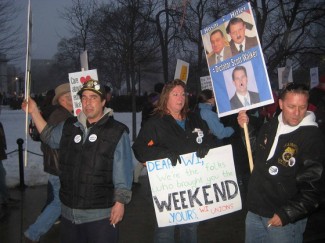
Sounds like a great template for states across the country. Unbelievably, the AFT web site describes these measures as a sign of disrespect to the workers. I know of no other retirement plan where workers contribute a paltry 0.2% of their pay for their own retirement and only 6% of their health insurance premium. In return for concessions, the governor has said their will be no furloughs (layoffs), and still the unions are stirring up huge trouble. Here is a picture of union protests from the WSJ:


And let's not forget the real import of the plan to reduce union power and therefore curb state deficits: it might harm Democrat electoral chances.

Proposals in Wisconsin and other states have "great ramifications" beyond the damage to union coffers and membership, said Gerald McEntee, president of American Federation of State, County and Municipal Employees, the nation's biggest public-sector union.

Unions have told the Obama administration that the state fights could affect the 2012 presidential election by draining unions' political resources, especially in states like Wisconsin and Ohio. "I think it can put him in some [political] danger," Mr. McEntee said of the president.

Good.

Cross posted to sdrostra.com. Don't forget to take our poll on renaming the Coronado Bay Bridge after Ronald Reagan, at right.

UPDATE

sdrostra.com commenter Michael A. Schwartz provides the following additional love for the Packer fan who is the governor of Wisconsin.
Gov. Scott Walker has also said he will sign legislation to turn Wisconsin into a “shall issue” state meaning that all law-abiding, sane, trained citizens will be able to obtain a concealed weapon permit for the purpose of self-defense. Wisconsin will join the 40+ other states that will choose not to trample Second Amendment rights. (California NOT being one of those 40+ and San Diego County having one of the worst track records in the state when it comes to issuing CCWs)

Wednesday, August 25, 2010

Reforming California's State and Local Pensions

Poster Boy for Pension and Salary Excess. The people of Bell, CA deserve to get their money back.

In a previous post, I thanked the U-T for forthrightly reporting that the root of the city's financial debacle is the granting of excessive pensions over the last decade. However, the most disturbing part of the article was this little paragraph:
For the most part, those changes affect new hires, with minor changes for the bulk of city employees and retirees whose promised benefits have strong legal standing to remain untouched. [emphasis added]
I don't know how the municipal pension law works in California specifically, but it needs to be change. In another post I looked at what was happening in Colorado and Minnesota where the states were being sued over changes in pension formulas. It appears to me that we need to amend the state constitution to allow pensions, even for current retirees to be reduced.

I think we should start work on an initiative that would modify the California constitution to allow cities and counties to reduce pension benefits of current employees as well as pensioners upon a vote of the people through a further initiative. Should a two-thirds protection apply? Perhaps, I wonder what you think. The constitutional amendment should be worded in a manner that invokes the sovereign immunity of the state of California to prevent suit in federal court. Without such a threat to enable city councils to negotiate reductions, we will be faced with the situation San Diego finds itself in:
In large part because of the 1996 and 2002 benefit increases, the city’s annual pension payment has grown.

In 2002, it was $54 million, or 7 percent of the operating budget.

Currently, the payment is $232 million, or 21 percent of the operating budget.

By 2025, it’s projected to be $512 million, or nearly 47 percent of the operating budget, if no changes are made to pensions or budgets.


Would that be legal? As a non-lawyer, it is hard for me to say. The concept of sovereign immunity would apply to California, so suit in federal court would not fly, especially if the changes were to the state constitution and specifically forbade suit in federal court. From wikipedia:

In Hans v. Louisiana, the Supreme Court of the United States held that the Eleventh Amendment re-affirms that states possess sovereign immunity and are therefore immune from being sued in federal court without their consent. In later cases, the Supreme Court has strengthened state sovereign immunity considerably. In Blatchford v. Native Village of Noatak, the court explained that

we have understood the Eleventh Amendment to stand not so much for what it says, but for the presupposition of our constitutional structure which it confirms: that the States entered the federal system with their sovereignty intact; that the judicial authority in Article III is limited by this sovereignty, and that a State will therefore not be subject to suit in federal court unless it has consented to suit, either expressly or in the "plan of the convention."
But what about the guarantee of a republican form of government and the prohibition against state abridging the privileges and immunities that citizens enjoy under the federal constitution under the fourteenth amendment? Under Article 1, Section 9, Congress is prohibited from passing any ex post facto law. Generally, the fourteenth amendment has only been applied to the bill of rights, but what about other sections of the constitution? And is a reduction of pension payments and ex post facto law, since it is a civil, not a criminal matter? I'm hoping Eugene Volokh can take this up.

I am open to suggestion as to how to get something like this going. I am not the organizing type. Tea party cause célèbre?

Sunday, August 22, 2010

San Diego's Fiscal Crisis and... Hooray for Newspapers


Hooray for Newspapers

Three times in two weeks, Southern California newspapers show why they are a necessary part of the political landscape, doing the job that the framers envisioned. Dean has a great post on the L.A. Times pulling data together on teachers and another on how they exposed outrageous salaries and pensions in Bell, CA. Today, the San Diego U-T, in its new styling, lays out the history of the pensions issue and points out the inescapable conclusion in their headline that the current proposal for a sales tax increase is directly traceable to the cowardly actions of former mayors Susan Golding, Dick Murphy, City Manager Jack McGrory and the pension board members. If they worked at Enron, they would all be in jail. I had previously surmised that the U-T was pimping for the tax increase, now I am not so sure. I reiterate Dean's point that only news organizations have the necessary resources and legal clout to pull together the information needed to expose the wrong doing of elected officials and government employees.

The Roots of the Crisis

The U-T article is a must read for all Tea Party types. It lays out in stark detail the shenanigans and the cost to the taxpayer of allowing the ruling class to have its way unsupervised. Some quotes:

The push for a half-cent increase to San Diego’s sales tax has just begun, but it actually goes back to past decisions by city leaders who chose short-term political expediency over the long-term interests of taxpayers. . . . For example, the highest-paid retiree in the city’s pension system, former Assistant City Attorney Eugene Gordon, would have been due an annual benefit of roughly $64,600 after his 34 service years if city leaders hadn’t significantly increased retirement benefits. . . . The design of the city’s pension changed again in 2002, but things only got worse. Golding’s successor, Dick Murphy, and the City Council established a new underfunding plan that called for a second benefit increase for retirees. Their action instantly created a $1 billion-plus pension deficit. The increase helped win the favor of pension board members, many of whom were city workers, to let the city put far less money into the pension fund than was required. . . .

Currently, the payment is $232 million, or 21 percent of the operating budget.

By 2025, it’s projected to be $512 million, or nearly 47 percent of the operating budget, if no changes are made to pensions or budgets.

Exit question: What should we do now, given the strong legal standing that the current pensioners and employees have? B-Daddy is still noodling and researching the question, but I need some input. This may be the battle of the the century.

Sunday, April 25, 2010

My Enemies List - Public Employees Unions

The blogosphere and the conservative and libertarian press have come alive lately reporting and documentation of how the public employees unions are buying off state governments and creating an unsustainable welfare state. The size of state government budgets accrues not only to the amount of "services" delivered by the state, but the cost per employee of delivering same. Included are burgeoning retirement costs, and generous health care benefits. To provide my readers with a little background on this subject and to remind us of why the Tea Party is so desperately needed by the people of this state and the country as a whole, I have a little round up.

Back in January, Reason magazine got me tuned in to the magnitude of the problem with their cover article, Class War, How Public Servants Became our Masters. From things as small as running red lights with impunity, to rigged retirement rules that lets public employees live of taxes for half their adult lives after they quit work, it dives into the whole entitlement mindset and the unions who enable it. They followed with this quick hitter, also posted on YouTube (also read the article):


The most blood boiling article was this one from Steve Malanga, The Beholden State, in City Journal. He focuses on the unions' highly successful in the California to increase their own pay, and specifically points to the methods behind their success. As previously noted, this got my blood boiling so bad, I needed a med check, and had to read it in small doses.


Meanwhile, union marches continue unabated to squeeze more tax dollars out of you. TempleOfMut linked me to this article where union marchers demanded $40 billion in tax hikes in California, that's right, in the middle of 12% unemployment in the state. Dean has some great video from Illinois, where the lefty political unions are demanding more tax hikes. Taken together, we see a movement that can only be compared to the communist party of the old Soviet Union, where membership confers privilege and wealth not available to the average member of society. I do not make such comparisons lightly.

Given this extraordinary level of self serving by these unions, and the fact that their heavy influence over politicians comes from campaign cash and get out the vote efforts, I think that the Tea Party members must never vote for candidates with public union endorsements; including police and firefighters, maybe especially. I know that police union endorsements used to mean a candidate was tough on crime, but it is safer to say that is no longer true. From Malanga:

Even cops who run for office have felt the wrath of public-safety unions. Allan Mansoor served 16 years as a deputy sheriff in Orange County but angered police unions by publicly backing an initiative that would have required them to gain their members’ permission to spend dues on political activities. When the conservative Mansoor ran successfully for city council several years back in Costa Mesa, local cops and firefighters poured resources into helping his more liberal opponents. “I didn’t like seeing my dues go to candidates like Davis, so I supported efforts to curb that,” Mansoor says. “Union leaders didn’t like it, so they endorsed my opponents by claiming they were tougher on crime than I was.”
This is why I can't bring myself to endorse Howard Wayne in San Diego Council District 6, even though he was the most knowledgeable at the debate I covered.

So as the unofficial chief ideologue, I am asking the Tea Party movement to not vote for those candidates endorsed by the public employees unions. Along those lines, I would ask that Democrat readers of this blog give serious consideration to supporting Mickey Kaus for U.S. Senate against Barbara Boxer. Nice article on Kaus at Politico.

Disclaimer: I am an employee of the Federal Government, though not represented by a union. The opinions I express in this blog are my own and not that of any agency of the federal government.