Showing posts with label Iraq. Show all posts

Friday, August 8, 2014

The Inevitable Fall of Iraq

Lately, I have been turning on CNN for coverage of the Middle East, and found them to be well, fair and balanced.  Anderson Cooper asks tough questions of guests and has a variety of them.  I was surprised at how well one guest summarized the roots of the conflict.  Essentially, the Shia majority under Maliki was abusive of its power towards the Sunnis.  (Of course, the Sunnis were favored by Saddam who brutalized the Shiites, but whatever.)  This has given rise to ethnic hatreds that fueled support for ISIS. ISIS claims to represent a swath of Arabic speaking peoples in the western Mesopotamia, parts of Iraq and Syria.  These people feel more loyalty to tribe than to the imagined country named Iraq.  Of course, I am not the first one to notice this. Writing in the CSM in 2007, O'Brien Browne laid out the case for separate nations to be carved out of Iraq.
Mesopotamia, as the region that includes Iraq was called until recently, had never been a "country" or "nation" in the modern senses of these words. The wise and largely benign rulers of the Ottoman Empire, who reigned over this land for centuries, realized that no outside force could ever rule this area by foisting preconceived notions of nationhood upon the population, whose loyalties lay with family, tribe, linguistic grouping, and religious orientation.
Unfortunately, when historic mistakes must be corrected, but the only means of correction is armed conflict, the most violent and ruthless group will come to the fore to lead the charge.  This is how the Bolsheviks came to power in Russia, to cite one well-known example. ISIS is nothing if not ruthless and bloodthirsty, but that will be their undoing as the administration of the apparatus of statehood requires skills other pure ideology.  Further, they have made too many enemies.  The governments of Syria, Iraq and Turkey are all going to work against them, as well as the Kurdish regional government.

Meanwhile, Browne saw the break up of Yugoslavia as instructive for what might need to happen in Iraq.
Unfortunately, this meant that wars had to be fought. Though vicious, cruel, and bloody, this process was vital. Its beneficial results can be seen on a modern map of the region: New countries such as Croatia have the telltale odd shape and wiggly lines of older, established, stable countries. Gone are those artificial border lines, the unreal trappings of a federation that should never have existed. Gone, for the most part, too, is the explosive anger that exists when ethnic groups are unwillingly thrown together. Instead, although Serbs, Croats, and the other groups do not love one another, they can now live alongside one another in relative harmony. Where this is not the case, as in Kosovo, ethnic tensions continue to bubble.
I think that ISIS has made too many enemies to survive, but the idea that the Sunnis of western Mesopotamia should have their own state will outlast these vile genocidal madmen.  There is no constitution capable of imposing trust between peoples riven by religious and ethnic conflict.

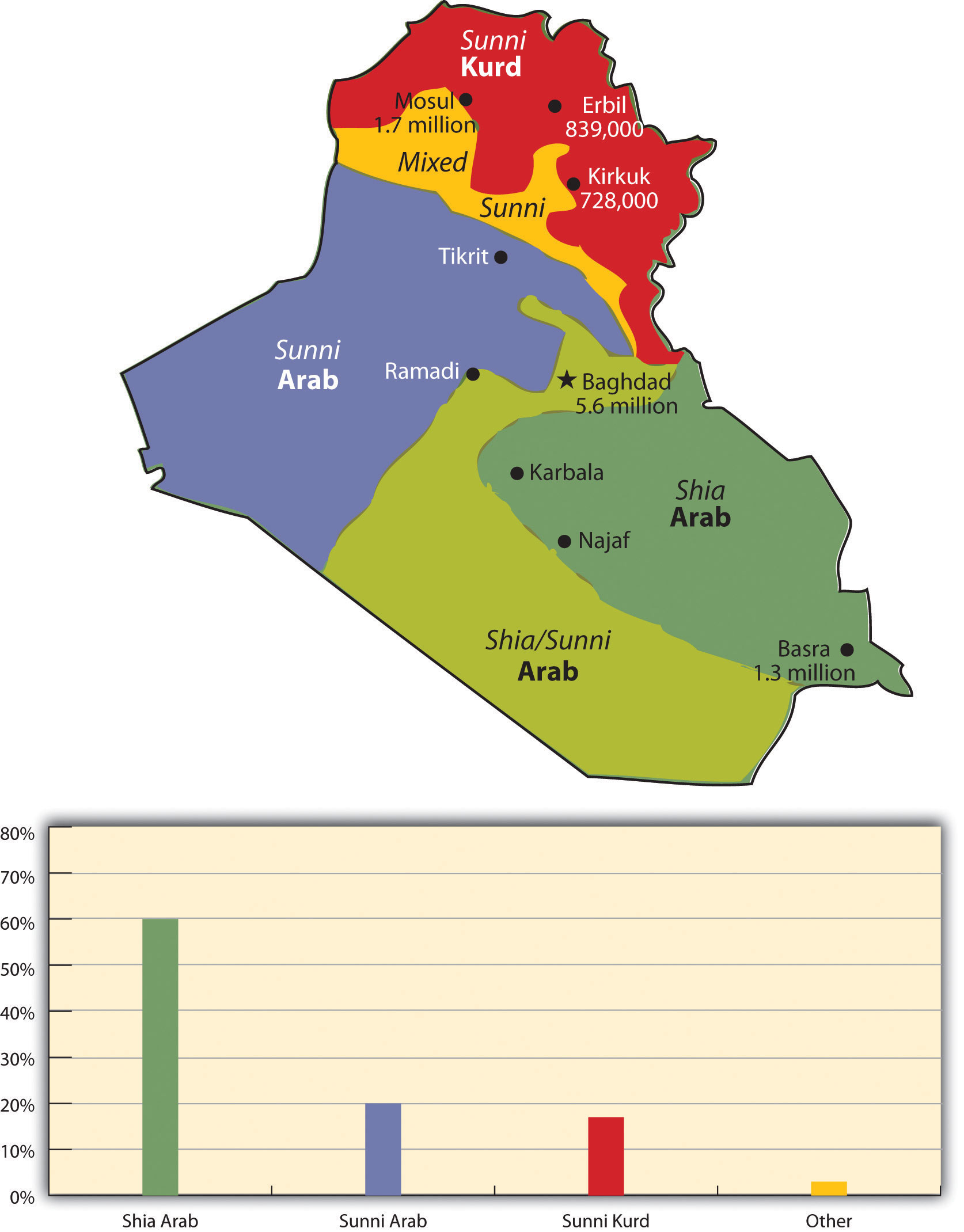
Some maps to help sort it out:  Iraq by ethnicity/religion source: Royal Burglee's Flatworld Knowledge web site:


Here is the situation today, according to a map on Wikipedia titled "Syria and Iraq 2014-onward War map" by Haghal Jagul - Own workTemplate:Syrian civil war detailed mapTemplate:Iraq war detailed map. Licensed under CC0 via Wikimedia Commons.


Map of Syrian Civil War and the Iraqi insurgency
   Controlled by Syrian rebels 
   Controlled by Syrian government 
   Controlled by Iraqi government 
   Controlled by the Islamic State in Iraq and the Levant (ISIS) 
   Controlled by Syrian Kurds 
   Controlled by Iraqi Kurds 
   Controlled by the Qaraqosh Protection Committee

Sunday, February 1, 2009

Fruits of Labor and Loss


Dean here. Iraqis went to the polls yesterday to vote for local representatives aimed at creating provincial councils that will control municipal budgets and have the power to hire and fire people.

There was a noticeable lack of violence with tight security including a driving ban in most of the country to prevent suicide bombing.
Nationwide, turnout varied: Some provinces hovered around 60 percent, with Basra, a Shiite-dominated region in the south, still lower at about 50 percent.

There was also some confusion in various areas as to where it was people were supposed to vote and there were reports of people being turned away because their names were not on the voter rolls.

Sound like anywhere else you know?
But a U.N. election observer, Said Arikat, described the election in mostly positive terms. “By and large, the rules were followed.”

Staffan de Mistura, the top U.N. official in Iraq, said, “This is a good day for Iraq's democracy.”

Long may the men and women of Iraq be able to argue and haggle over hanging chads, disenfranchisement and voting irregularities.

And God Bless the men and women of this and other coutries' armed forces who made what seemed an impossibility 6 years ago, a reality.

Saturday, January 17, 2009

And Yet...

As we close the books on the Bush Presidency in just a few days, there is much for conservatives and libertarians to regret over the last eight years. I twice voted for Mr. Bush, so you might say that I have little excuse for this hand wringing. As KT points out, the alternative was worser, so I have no regrets about my vote. Still I have a long list of complaints about the last eight years, so I will let fly.

1. No Child Left Behind. Anytime you see a so called conservative teaming up with Teddy Kennedy, you can be sure mischief is afoot. This vast intrusion on local school systems, however well intentioned, is out of the constitutional purview of the federal government. Further, it will retard much needed scholastic experimentation for decades to come.

2. Indifferent support of free trade. In 2002, Bush imposed steel tariffs to buy a few votes in the Rust Belt, showing a total moral indifference to the defense of the principles of free trade. Despite lifting them later, he sent the message to the rest of the world that he didn't really care about the issue, setting back international negotiations.

3. Indifference to the constitution. From foreign wiretaps to Guantanamo, Bush acted as if his commander-in-chief powers trumped the rest of the constitution. While I agree with the policies per se, I disagreed vehemently that the President had the authority to implement them unilaterally. On the foreign wiretaps, of course they have provided valuable intelligence, that's why even Democrats voted for changes to FISA when it came to a vote. So why would the administration lay themselves open to charges of illegality when they could have got this legislation so easily passed. Further, it has been argued that it is too difficult to get judges to approve the needed surveillance. Baloney, if it is that important, then create enough special judgeships to oversee the program. We spend enough on the war itself, spend enough to make sure surveillance is conducted legally. Same for military tribunals and the Gitmo prisoners. Do they deserve to be treated as POWs under treaty? Obviously not, but the President lacks the authority to invent a procedure to deal with unlawful combatants out of whole cloth. When Republicans controlled both chambers, surely he could have gotten the procedures and avoided a smack down from the Supremes.

4. Incompetent execution of the war. I was on active duty when Donald Rumsfeld was selected as Secretary of Defense. I remember his emphasis on re-shaping the military to a smaller force with more emphasis on special forces and air power. I disagreed at the time, and believe events in Iraq have proved me out. While I have no smoking gun, there is no doubt in my mind that we went with too small a force in the initial Iraq invasion. The initial looting became important as a tipping point, letting thugs and terrorists (but I repeat myself) know that we lacked the forces to control the country. Displacing a government will always take fewer forces than maintaining effective control of a nation, and we should have known better. Further, we mindlessly de-Baathisized Iraq, but were left with no one who knew how to manage vital civic services. We have only recently found our footing and not because of the geniuses and cowards in the Pentagon. (I don't use that term lightly, Generals and Admirals have a duty to resign and speak out when the administration is being criminally stupid, but those guys valued their pensions and promotions more than their duty.)

5. Indifference to social security reform. Bush gave up on the ownership society way to easily. He failed to communicate and let constant naysayers Pelosi and Reed get the best of them, even though, by their own admissions, they had no better plan to deal with the Ponzi scheme that is called social security.

I could go one, but these are my chief complaints. Do I blame Bush for the recession? To the extent that it is due to the war and other spending putting us into deep debt, yes. So by this reckoning, it would seem that his was a failed presidency.

And yet....

I'm still not sure. The book "Good to Great" talks about the hedgehog, who only has to know one thing to defeat the much more clever fox. George Bush may be that hedgehog in that he knew this: Allowing the drift of events and opinion in the Middle East to continue unchecked would inevitably bring far greater tragedy to the world than the events of 9-11. Something huge needed to be done, something that only America could do, something that would demonstrate our commitment to democracy as well as serve as a reminder that we remain the most powerful nation on earth. A confluence of events made that something a place and a war called simply "Iraq." Only time will tell if he was able to reverse the course of history. I am certain only of this, on the most important decision he had to make on his watch, George Bush got it right. We hope and pray that Barack Obama will be similarly fated.

Saturday, November 22, 2008

Today is Victory in Iraq Day

What if we won a war but nobody gave a parade to celebrate the victory? Gateway Pundit makes the most compelling case that we have won the war. Zombietime has organized the pro-freedom wing of the blogosphere to recognize an event that the MSM and our government don't want to acknowledge. I am proud to add my voice to this effort, small though it may be.

I am ill equipped to add to Gateway Pundit's fine analysis of how and why the war was won. I am more concerned about the reasons that the administration won't declare victory. I believe it is a combination of embarassment (remember "Mission Accomplished") and cowing by the MSM. But here is where the weaknesses of the Bush administration become so glaring. This administration has never been temperamentally suited to the traditions of the republic. Too often it is willing to go it alone and take unpopular stances. So far, so good, if they are upholding the best interests of the nation. Unfortunately, our form of government calls for congressional oversight of the executive and counts on a free press to monitor the actions of the federal government. That puts the responsibility for making the case for unpopular actions on the President of these United States. George Bush failed to make his case, an even more glaring crime when one considers that the facts were on his side. Bill Clinton was criticized for being in perpetual campaign mode, but I believe that is necessary to achieve the agenda of the Presidency.

Further, the President failed to involve the Congress in achieving consensus on the means to prosecute the war. The foreign wiretapping issue is perfectly illustrative. When finally put to an up or down vote, Congress approved legislation that allowed the executive to take the required actions. But Bush's unilateral pursuit of this course of action appeared made him appear lawless and unconstitutional, thereby undermining support for the war. Same for the Gitmo tribunals. No way do the terrorists deserve the protections of the U.S. constitution. But the President lacks the constitutional authority to set up tribunals outside of the purview of courts or the congress.

Sorry to rain on the celebration, but this is important to remember as conservatives and libertarians lay out the principles that will rest the moral high ground from the left.

MOST IMPORTANT OF ALL, WE SAY THANK YOU TO THE TROOPS, WHO MADE VICTORY POSSIBLE.